Separ8: sort a whole inbox in seconds, then see which answers to trust
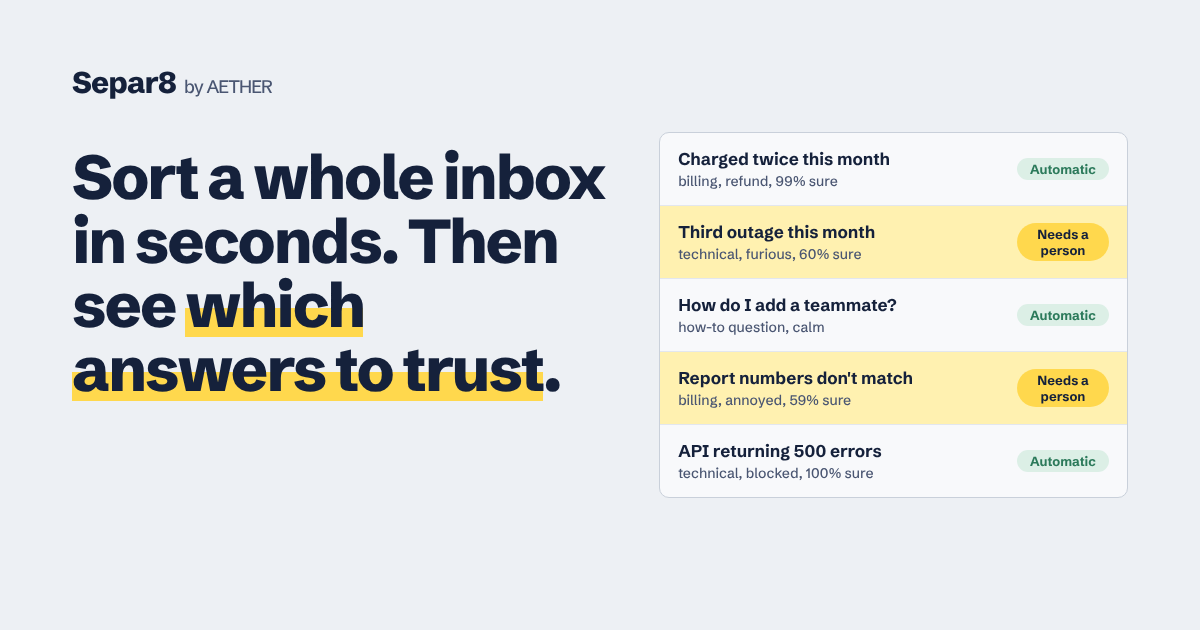
Today AETHER is opening early access to Separ8, a tool that answers plain-English questions about every row of an inbox, lead list or spreadsheet at once, then measures how far those answers can be trusted before anyone relies on them.
Why we built it
Most teams have a pile someone reads by hand just to decide what happens next: support tickets, inbound leads, product reviews, applications. The reading isn't the work. The decision is: which team, how urgent, does this need a person.
In September, TypeSafe released Jev, a model built for exactly that kind of decision. It doesn't write. It answers questions you define, with a probability for each answer, in a fraction of a second, for about four cents per million tokens of input. Developers took to it fast, and the demos were everywhere.
But two things stood out to us. Nearly every tool built on Jev so far is for engineers: command-line scripts, SDKs, SQL functions. And the independent research kept saying the same thing: Jev's confidence numbers aren't reliable out of the box. One audit found its calibration shifts with the task and even with the wording of the same question. So the number that's supposed to tell software when to act on its own can't be taken on faith.
Separ8 is our answer to both. It gives non-engineers a way to use a decision model on their own data, and it makes them check the model before they trust it.
How it works
- Describe the decision. Upload a CSV, or start from a sample, and say in a sentence what you need to know. "Route each email to the right team, flag anyone asking for money back." Separ8 drafts precise questions, defines every answer, and adds a way out for rows that fit nothing. You can edit all of it.
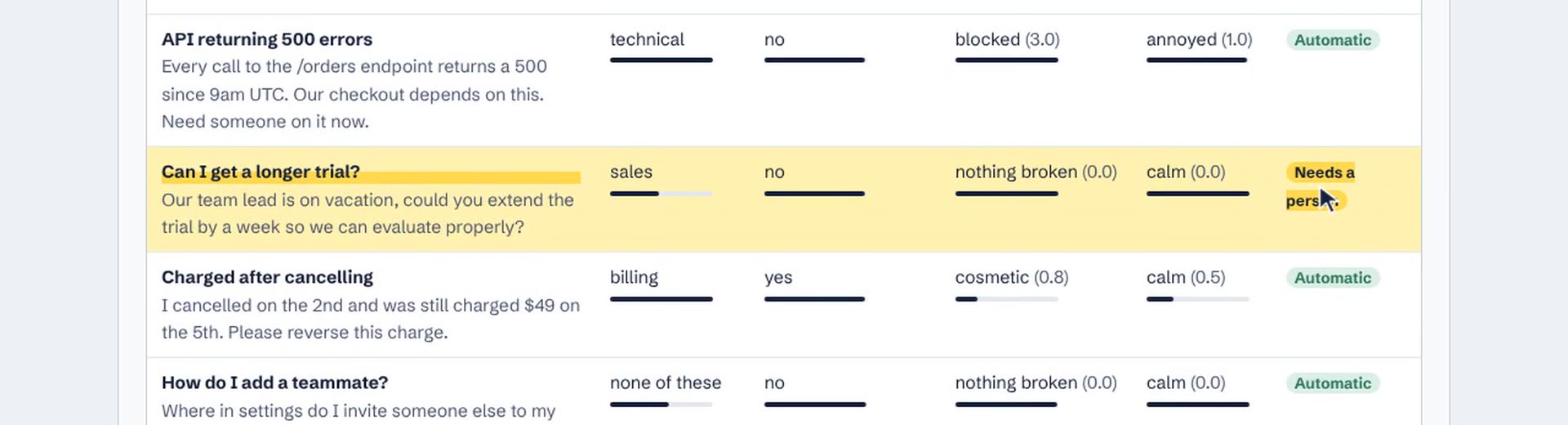
- Sort everything at once. Every question runs on every row in parallel. You get a summary of every answer and a table showing each row's answers and how sure the model was.
- Check, then trust. You mark the right answer for 20 to 50 rows. Separ8 measures how often the model agreed with you at each confidence level, then finds the line that meets the accuracy you choose. Rows above it can be handled automatically. Rows below it go to a person, highlighted.
The third step is the point. A model that's 90% sure isn't right 90% of the time just because it says so. Your own answers are what turn its numbers into a line you can stand behind.
What we saw in testing
We built three fictional datasets and ran each through Separ8 with four questions per row. Every sort finished in under two seconds and cost less than half a cent.
| Dataset | Rows | Questions per row | Time | Model cost |
|---|---|---|---|---|
| Support inbox | 116 | 4 | 1.2 s | $0.0041 |
| Sales leads | 60 | 4 | 0.5 s | $0.0020 |
| Product reviews | 60 | 4 | 0.5 s | $0.0017 |
It caught every safety problem we planted. We wrote six of the 60 reviews to describe a hazard: a carafe that cracked and splashed hot coffee, a kettle that sparked, a mixer that smoked. Separ8 flagged exactly those six. A review about a lingering chemical smell came in just under the line at 31%, the kind of gray-area case a person should see anyway.
The trust check told the real story. On the support inbox we checked 20 emails by hand, giving our honest answer even on the gray-area ones. The model agreed with us 75% of the time overall. That's not good enough to automate everything, and Separ8 doesn't pretend it is. The pattern underneath is what matters: of the 10 answers Jev was at least 95% sure of, all 10 matched ours; of the 10 it was under 60% sure of, only half did. With a 90% accuracy target, Separ8 recommended handling 93% of emails automatically and sending the other 7% to a person.
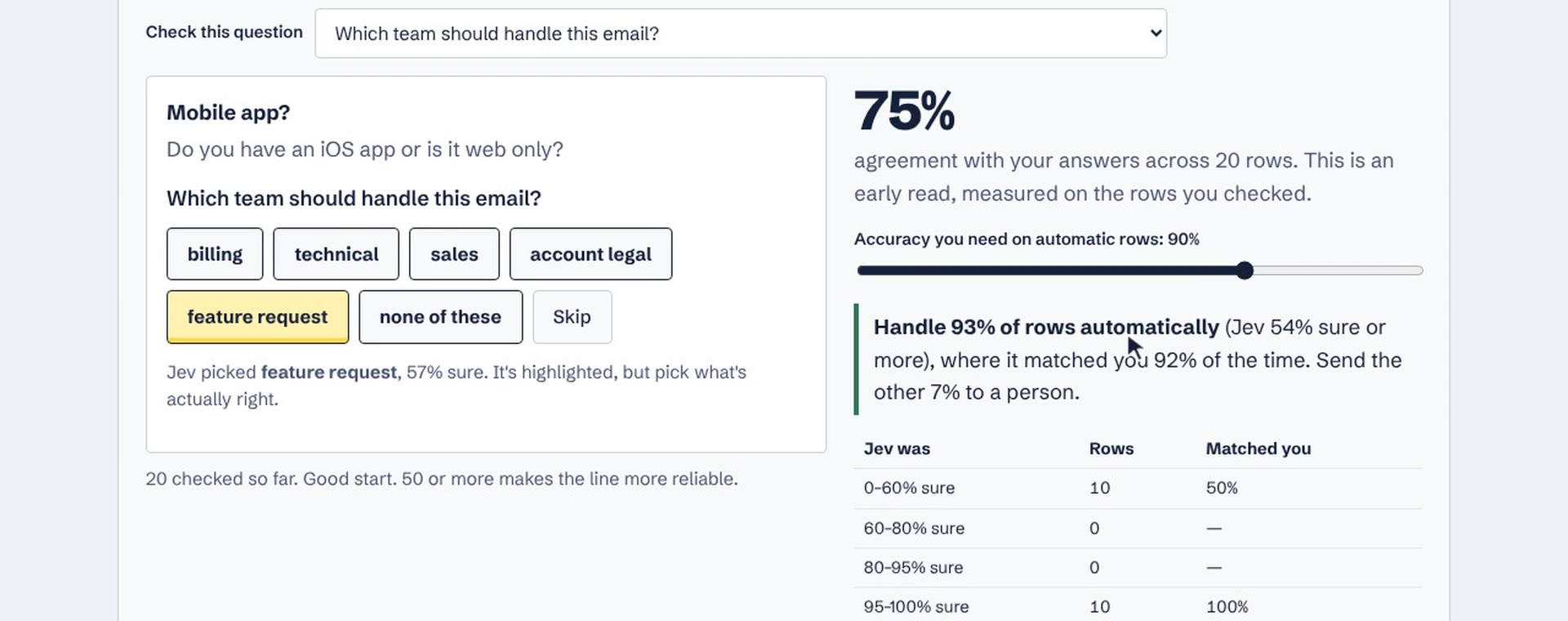
Twenty checks is an early read, and the app says so. These datasets are also ones we wrote ourselves. Real inboxes are messier, which is exactly why the check is built in rather than left to faith.
Where it fits
Separ8 helps anywhere people read a pile one item at a time just to decide what happens next.
| Team | What Separ8 decides | What changes |
|---|---|---|
| Support | Which team, refund or chargeback risk, how blocked and how angry | The angriest, most-blocked customers are at the top of the morning queue |
| Sales | Fit, timeline, budget, real intent | Recruiters, vendors and students drop out; buyers who need it this month rise |
| Ecommerce and brands | Safety risk, topic, needs a reply, sentiment | Reviews mentioning burns or sparks are caught the day they land |
| Operations and finance | Category, needs approval, unusual or routine | Only the unclear transactions reach a person |
| Legal and compliance | Request type, clause type, risk level | Lawyers start with the items that actually need them |
| Product | Feature area, urgency, bug or request | Roadmap calls start from counts, not anecdotes |
One caution: for hiring, Separ8 should flag and people should decide. Researchers at Bocconi University found Jev can be swayed by irrelevant numbers and by the order answers are listed in. We also recommend removing names and other personal details first.
Self-serve or done for you
You can use Separ8 yourself today, or have AETHER set it up and run it for you.
| Self-serve | Done for you by AETHER | |
|---|---|---|
| Best for | A pile you want sorted today | Decisions that happen every day |
| Setup | About ten minutes: upload a CSV, describe the decision, edit the drafted questions | We connect Separ8 to where items arrive (inbox, helpdesk, CRM, forms), write and test the questions with your team, and run the trust check on your real history |
| Reports | A summary of every answer, every row with its confidence, and a CSV export | Results land where you already work, plus a monthly report: volume, share handled automatically, accuracy against fresh spot checks |
| Ongoing | Re-check 20 rows whenever your data changes | We watch for drift, re-measure when the model updates, and adjust the questions as your business changes |
Today the app works with CSV files. Connections to live systems are part of the done-for-you setup, built for each client.
The live demo runs on real models with three sample datasets, and you can upload your own CSV of up to 500 rows. The two-minute walkthrough shows a full run, from a raw inbox to the trust check. We're opening Separ8 to a small group first.
Sources
- Lingsen Meng, How far can a commercial decision model's probabilities be trusted? A calibration audit of Jev, UCLA, 2026.
- Imperatrice, Kameneva, Greenberg and Romano, Are AI Decision Models Biased? A Case Study of Jev, Bocconi University, 2026.
- Lindy, What Is Jev AI? TypeSafe's Decision Model, Pricing and Limits.